8. What to say on a call
An owner wrote back, or tapped the button. Now you talk. A call is not a performance. It is a short, kind conversation where you show one thing and ask one question.
Before the call
Ten minutes of getting ready beats an hour of talking. Do these six things first.
- Open the owner’s website on your phone. Find the one problem again. Say it out loud in one sentence.
- Open your sample website on your phone. Check that it loads.
- Open the report from chapter 4. Keep it ready, but do not read from it.
- Decide your price, and what it includes and what it does not (chapter 9). Write it on a card. Say it out loud once, alone, until it sounds normal.
- Have your one-page agreement ready (chapter 9). Pay a lawyer in your state to fix it before your first call, so it is ready when someone says yes.
- Decide when the call ends. Twenty minutes is plenty. Say it at the start.
Do not record the call unless you ask first. The rules differ by state, so ask a lawyer where you live. To show your sample, use any video call tool you already know, or just send the link.
Look at what small web designers near you charge for a simple site. Pick a number you can say without flinching. Then keep it. A price you change in the middle of a call tells the owner the first number was a guess.
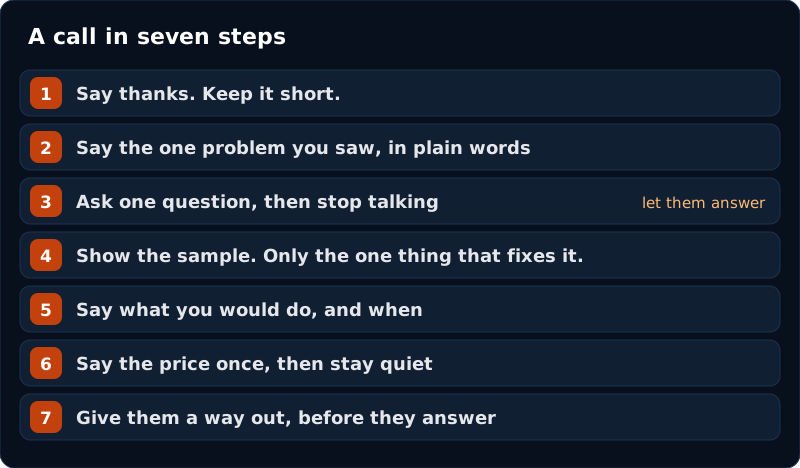
A call in seven steps
- Say thanks. “Thanks for taking a few minutes. I will keep this short.”
- Say what you saw. One problem, in plain words. “When I opened your site on my phone, the number did not tap to call.”
- Ask one question, then stop talking. “How do most of your customers find you today?” Let them answer. Count to ten in your head if you need to.
- Show the sample. Share your screen or send the link. Show the one thing that fixes the problem. Do not tour every page.
- Say what you would do and when. “I would build this on your own domain. You would see it before it goes live. Here is the date I can finish.”
- Say the price, plainly. Say it once, then stay quiet. Do not fill the silence.
- Give them a way out. Say the line below, before they answer.
The line that helps most
If this isn’t for you, just tell me and I’ll drop it. No hard feelings.
Owners get pitched all day. Few people tell them it is fine to say no. It is also true, so it works twice. Say it every time.
What owners say, and honest answers
Do not argue with any of these. Agree first. Then answer with something true.
“How much is it?”
Say your number. Say what is in it, in one line. “It is a five-page site, built on your own domain, with one round of changes.” Do not ask them what their budget is. It sounds like a trick.
“Will this get me more customers?”
I cannot promise that, and anyone who does is guessing. What I can do is make it easy for people who already find you to call you or book.
“I already have someone for my website.”
“Good. Keep them. I only wanted to show you what I noticed.” Never compete with a relative or an old friend. If they handle the site, you can look at one other thing later, like the phone or reviews.
“I need to think about it.”
“Of course. Is there something you are unsure about?” If there is, answer it. If not, say: “No rush. I will send a short summary today, and you can reply when you are ready.” Then send it, and leave it.
“Can you do it cheaper?”
Do not cut the price on the spot. Offer a smaller job instead. “I can do three pages instead of five, for a lower price. Would that work?” The price stays. The size changes.
“Why did you email me?”
“I looked at your website on a phone and saw one thing that makes it harder to call you. I sent you the report so you can see it yourself.” Say only what you saw.
“Where did you get my email?”
“It is on your own website. I wrote to you about one thing I saw. If you would like no more emails, say so and I will not write again.” If they say so, mark them No thanks.
“Two other shops near you are looking at this.” “I only work with one business per town.” “The price goes up on Friday.” Owners have heard all three this month. If it is not true, it is a lie in your own mouth. If it is true, show them where it is written.
Also never promise rankings, customers, calls or money.
When it is not a good fit
Some jobs are not worth taking. You can see it in the first call.
- They want the real site for free, “to try it.”
- They ask you to invent reviews, awards or years in business.
- They want a lot more than you offered, for the same price.
- They are rude to you in the first call.
- They cannot say what the business does.
Say no kindly and clearly:
I do not think I am the right fit for this one. I would rather tell you now than let you down later. Good luck with the business.
Mark it No thanks in Manage Leads and move on. SiteRevive keeps it out of your next prompt. One good client is worth more than five bad ones.
After the call
- Send a short note the same day. What you talked about. What happens next. The date.
- In Manage Leads, mark the business Replied if it is still open, or No thanks if they said no.
- When they say yes, mark it Won, then go to chapter 9.
Talking for ten minutes before asking anything. Ask, then listen.
Showing five things. Show the one thing that fixes the one problem.
Making up a price on the call. Decide it before.
Chasing a no. A no is an answer. Say thanks and stop.
Check yourself
- I know the one problem I will name, and I can say it in one sentence.
- My price is written on a card.
- I will say the permission line before they answer.
- I know how I will say no to a bad fit.
Next: what to do the moment they say yes.