10. Add more services, in order
Your first job is a website. Most owners have more than one problem. This chapter is about what to offer next, and when. The short answer: one thing at a time, only after the last thing works.
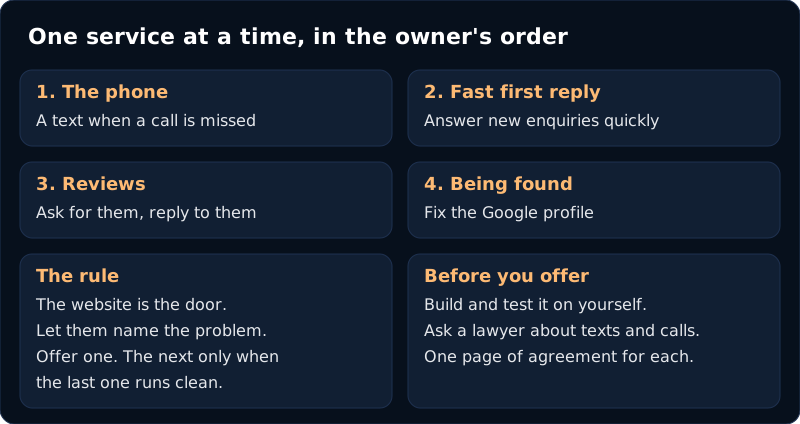
This chapter is for after your first website is live and the owner knows you. No client yet? Skip to chapter 11 and keep going with chapters 3 to 8. Never put these services in a cold email.
The rule
- The website is the door. It is the job that earns trust.
- Wait for them to tell you. At your thirty-day check-in (chapter 9), ask the one question: what has been eating your week?
- Offer one service. The one that matches what they said. Not a menu.
- Offer the next only when the last one runs clean. If something is still broken, your next call is a check-in, not a pitch.
Owners forgive a rough start. They do not forgive being sold the next thing while the last thing is still broken.
Do not offer a service you have not built and tested on yourself. Texts and calls have legal rules. Before you turn on anything that texts or calls people, ask a lawyer in your state, and write down where each person gave permission. Each new service also gets its own one-page agreement before any work starts.
When you talk about a new service, keep this order: their number, one sentence on how it works, show it, say the price, then say this last, before they answer:
If now is not the time, tell me and I will leave it alone. Nothing changes with your website either way.
No fake scarcity. See the “Never say these” box in chapter 8.
Match the complaint to the service
| They say | You offer |
|---|---|
| “I can’t get to the phone.” | A text that goes out when a call is missed, and later an automated phone helper |
| “People fill in the form and go quiet.” | A fast first reply, then a few short follow-ups |
| “We got a bad review.” Or “We have so few reviews.” | Asking every customer for a review, and replying to every review |
| “Nobody finds us.” | Fixing their Google profile and answering real customer questions on their site |
If the owner names something else, listen. Their own words beat this table.
Which one first, by kind of business
- Plumbers, electricians, roofers. The phone. The call comes when their hands are busy, and the caller dials the next number on the list.
- Dentists and spas. Messaging past customers, but only people who said you may. Check permission first.
- Restaurants and salons. Reviews. People pick them from the stars, at the moment they choose.
- Lawyers and accountants. Being found. Buyers read and research before they call.
That is a starting guess. The owner’s own words always win.
1. The phone
The simplest version: someone calls, nobody answers, and a few seconds later they get a text. “Sorry we missed your call. This is Sample Plumbing. Want a call back, or a time to book? Reply STOP to stop texts.” It gives that caller a quick answer. Nobody can say how many will wait.
The bigger version: an automated phone helper that answers, says plainly that it is automated, asks what the caller needs, and then does one of three things. It books a time. It takes a message. Or it passes the call to the owner’s own number for an emergency.
- Say the helper is automated at the start of every call. Always.
- Before it passes a call on, it should say: “If anyone is in danger, hang up and call emergency services.”
- Forward the calls. Never take over the owner’s phone number. The owner can switch it off on their own phone account.
- Ask a lawyer whether calls may be recorded or written down where you live.
- Texting platforms may need a business registration before the first text. Check before you promise a date.
- Call the test number yourself about ten times before it touches the real line.
- It should never quote a price or tell anyone what is wrong with their pipes, teeth or taxes.
- Let the owner call the test number himself before it touches his real line.
- Some professions have rules about who may speak to a client. Ask a lawyer in your state first.
2. Fast first reply
When someone fills in a form, they are still looking at their phone in the first minutes. You can check how fast the owner replies today in their own inbox. A person under a sink cannot be first every time. A tool can answer quickly.
- The reply goes out within a minute and sounds like the owner. They approved the words.
- It asks one question, or offers a booking link. No prices. No promises.
- If they do not answer, a few short follow-ups over about ten days. One point each. The last one says it is the last.
- Stop when they reply. Stop when they book. Stop forever when they say STOP, in any words.
- Never more than one message a day. Never at night. Use the quiet hours of the person’s own time zone.
- Every text names the business and says how to stop.
- A reply, or any word like emergency, leak, refund, cancel, lawyer, or a question about price, goes to a human. The tool does not answer it.
- Only message people who contacted the business, or who said you may. Texting rules differ by state, so ask a lawyer.
This is the riskiest service here. Do not offer it until a lawyer has read your plan and you can show, for every name, where they said yes. Never use a bought, shared or scraped list, or anyone who ever asked to stop. Reaching old customers is only allowed with real permission.
3. Reviews
- When a job is finished, the customer gets a short text with the review link. Every customer. Not only the happy ones.
- One reminder a few days later. Then stop. Two messages is plenty.
- Every review gets a reply under the owner’s name. Drafted by AI, read by you. Anything of three stars or below, any complaint, anything about price, a refund, an injury, or a legal-sounding line waits for the owner.
- The review request is a text. The same texting rules apply: name the business, say how to stop, and ask a lawyer.
- Four rules for every reply: never argue, never invent anything, never promise, never share a customer’s private details.
- A one-star review gets thanks for telling us, no defence, and an invitation to call.
Be honest with the owner: this does not make a bad business look good. It makes sure a good business gets asked for the reviews it has already earned, and answers them.
Never buy reviews. Never write fake ones. Never give a gift, discount or prize for a review. Never ask for a rating first and send only the happy ones to Google. If an owner asks you to, say no, kindly, and say why.
Dentists, doctors, spas and lawyers: even a reply that says someone was a patient or client can break privacy rules. Ask a lawyer before you reply to their reviews.
4. Being found
Some people now ask an AI tool, or read the answer at the top of Google, before they scroll. Nobody can say how many in your town. Those answers name a short list of businesses. Nobody can promise a place on that list. What you can do is make everything the tools read about the business complete and the same everywhere.
A simple Google profile check
- You are a manager on the profile, from your own account. You never use their password.
- The main category says what the business really is.
- Every service they offer is listed, with a plain line each.
- The description says what they do, where, and for whom. No “best” or “number one.”
- Photos are real, recent, and from the owner’s phone.
- The hours are right, including holidays.
- The name, address and phone number are the same everywhere: the website, Google, Facebook, Yelp and the rest. “Suite 200” and “Ste. 200” can look like two different places to a machine.
Questions on their website
Write down ten real questions customers ask on the phone, in the customers’ own words. Answer each in plain sentences on a page of their site. Use only facts the owner has confirmed.
Walk away from anyone who hides words on a page. Walk away from anyone who sells lists of mentions by the hundred. Walk away from anyone who promises a spot in an AI answer. Teach the owner to do the same.
Show it with the owner’s own numbers
Do not quote a statistic from the internet. The owner will not believe it, and you cannot prove it. Their own phone, inbox and profile are better proof, and they are sitting right there.
| Service | Open this with the owner | Count this |
|---|---|---|
| Phone | The call list on their phone, last thirty days | Calls in, calls missed, calls after hours |
| Fast reply | Their form inbox, last twenty entries | When it came in, and when someone first replied |
| Reviews | Their Google profile, in a private window | Reviews in a year, and how many have a reply |
| Being found | An AI tool, asking who is a good one in their town | Whether their name is in the answer. Screenshot it, with the date. |
Show the numbers back. Then stop talking. Do not turn them into “lost money.” You cannot know how many of those callers were wrong numbers. Say only what you counted. What it means is for the owner to decide.
Ask before you look at their phone, form inbox or review list. If you take a screenshot, cover your customers’ names and numbers. A screenshot of an AI answer shows one search on one day. Another day it may be different. Say so.
Show the answer, not a made-up result. Never show a review, a booking or a lead that is not real. Use a test setup to show how it works, and their real profile to show their real situation.
Offering four things on one call. They will buy none. Offer the one that matches their words.
Adding a service while the last one is shaky. Fix first.
Promising a rank, more calls, or more money. You cannot know.
Messaging a list nobody agreed to. It can harm the owner and you.
Check yourself
- I wait for the owner to say what is eating their week.
- I offer one thing, matched to their words.
- I show their own numbers, not a statistic.
- I never promise a result, and I never fake anything.
- I know which things I will ask a lawyer about before I use them.
Next: a worksheet to plan your weeks and your numbers.