Is a Free Sample Website Spec Work? Rules That Keep It Fair
 By Ryan Shaw. Published . 5 min read.
Key takeaways
- By the usual definition, a free sample site is spec work: work done before any agreement to pay.
- Design groups like AIGA warn about spec work for good reasons: unpaid time, rushed quality and clients who take the idea and leave.
- A sample is easier to defend when it is private, labelled, built from the owner's own public facts and removed the day they ask.
- AI lowers the cost of a sample. It does not remove the duty to check every fact and respect the owner's no.
- You can skip samples entirely. A short, honest note about one real problem is a fair first step too.
On this page
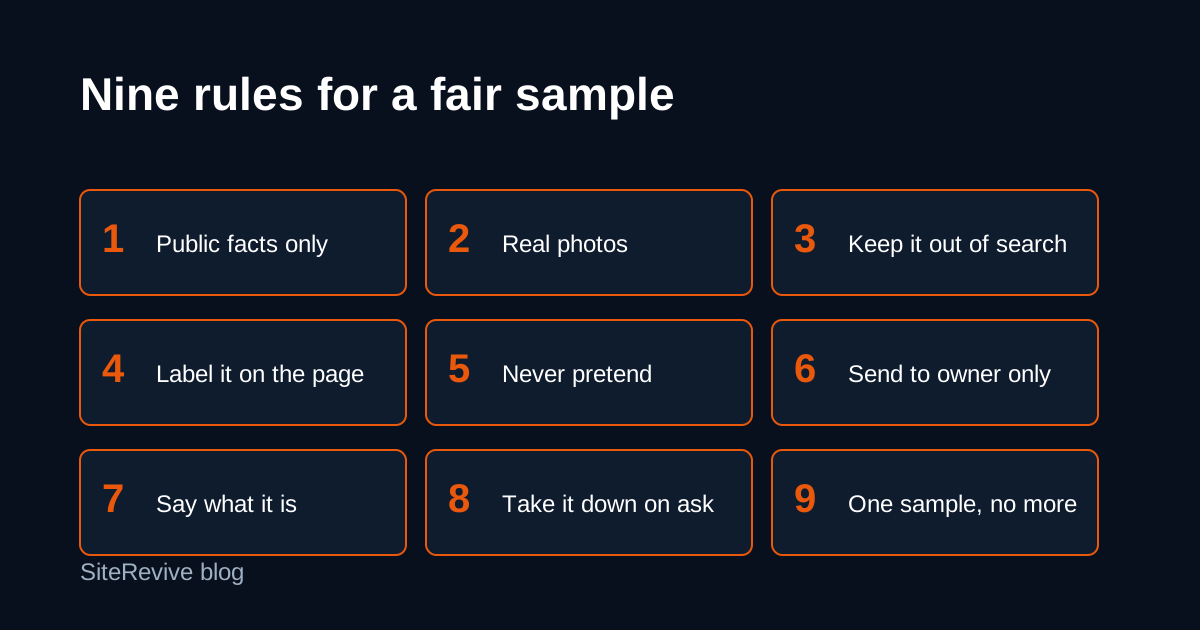
A free sample website for a business you hope to sign is spec work. AIGA, the professional design association, describes spec work as unpaid work done before a client engagement, in hope of payment. A sample site fits. So the useful question is not whether it counts. It is whether you can do it in a way that is fair to the owner and fair to you. This post gives the case against, and nine rules that make a sample easier to defend.
I ran a marketing agency for 15 years and worked with 100+ agency clients. I have strong feelings about people working for free. What follows is my opinion, not legal advice.
What the critics get right
Read the AIGA position on spec work. It is short and fair. It does not forbid anything. It asks designers to understand the risks first. AIGA names two:
- Little time, energy and thought can go into speculative work, which can hurt quality.
- Designers risk being taken advantage of.
Both are real for a sample site.
Quality risk. A sample built fast and sent to a hundred businesses is a weak sample. The owner sees a template with their name on it and learns nothing about how you work.
Taken advantage of. An owner can look at your sample, close the tab and hire a cousin to copy it. You cannot stop that. If your business depends on every sample turning into a sale, you will be unhappy.
There is a third risk the critics talk about less. A sample can mislead the owner about what they will get. A page built in ten minutes by an AI, with photos from their own site, can look better than a paid project will after real changes, real hosting and real support. Say so in your email.
What changes when AI builds the sample
AI makes the first draft cheap. That changes the cost to you, not the duty to the owner. In one of our own runs (SiteRevive data, October 2026), Codex worked through 33 New Jersey businesses in one prompt and finished 30 sample sites. None was published and no email was sent. That is a lot of free work the owners never asked for.
Cheap work tempts people to do too much of it. The more samples you make, the more likely one has a wrong phone number, a photo that is not the business's, or a page that reaches the wrong owner. Check every one. Our guide to confirming the right business covers the checks.
Nine rules for a fair free sample
These are the rules we follow on our own samples. They are not a legal standard. They are what I would want if someone built a page about my business.
- Use public facts only. Name, address, phone, hours, services and photos come from the business's own site or Google listing. Never invent a service, a price, a review quote, an award or a license. Our sample prompt forbids all of them.
- Credit and keep photos honest. Use the owner's real photos where they exist and never use another business's pictures or customer review photos. See real photos vs AI images.
- Keep it out of search. Add a noindex rule so a page about a business that never asked for it does not appear in Google. Google documents the noindex tag.
- Label it on the page. Our samples say "Free preview made for [Business]. Not the official site." in the footer, and the placeholder text says "Sample content, we will use yours." Nobody should mistake it for the real site.
- Do not pretend to be them. No copying of the owner's logo as if you were the company, no claiming to be a customer, no invented backstory.
- Send it to the owner only. One link, one email, to an address you found on the business's own site. Follow CAN-SPAM: your real name, a postal address and an easy way to opt out. See also is cold email legal for web designers.
- Say what it is. "This is a sample built from your public website. Nothing is live." A plain sentence prevents hard feelings later.
- Take it down the day they ask, and stop writing to them. Log the request so you never contact them again.
- Offer one sample, not a free redesign. If they want changes, that is the start of a paid project. Say so kindly.
Where we apply these
Take the sample restaurant site we built from a New Jersey restaurant's public website (SiteRevive data, October 2026, name hidden). We saved 14 photos from the restaurant's own site, sized to at most 1600 pixels wide, and the page uses 12. We skipped catering tray photos and stock-looking banner images. We kept hours and the address as the site showed them. The draft email was five short lines and ended with "If you like it, I can put it live for you. If not, no hard feelings." The page was never published.
Our cold email example post has the full wording for these emails.
When not to build a sample
Skip it when:
- The owner has already said no, to you or to someone like you.
- The business is large, with a brand team. They have their own designers and your sample may cause trouble.
- You cannot confirm the business is open and the contact is real.
- You cannot trace the photos you would use back to the owner.
- You would be upset if it came to nothing. Then charge for a small paid audit instead.
Other ways to start the conversation
A sample is one door. You can also:
- Send a short note about one problem you saw and a link to your own past work, with no sample at all.
- Offer a paid mini-audit with a written list of findings.
- Show a sample of a different business you built with permission.
For more on showing work to an owner, read how to show a website preview to a business owner.
Where SiteRevive fits
SiteRevive finds local businesses and writes down their real website problems. When you press Copy prompt, it gives your own AI the facts for each sample, and the prompt tells the AI to use real photos, mark each page as a sample and keep it out of search. Your AI builds the pages, and the emails go from your own account or wait as drafts. SiteRevive's servers never send email. It does not promise replies or sales.
Plans start at $97 a month, with a 7-day money-back guarantee, no questions asked. Details are on the SiteRevive pricing page. If you are new to all of this, start with how to start a website agency with AI.
Questions people ask
Is building a free sample website spec work?
Yes, by the common definition. AIGA describes spec work as unpaid work done before a client engagement, in hope of payment. A free sample for a prospect fits that. The question is whether you run it fairly, not whether the label applies.
Why do designers warn against spec work?
AIGA says little time and thought can go into it, which can hurt quality, and that designers risk being taken advantage of. A client can also take the idea and hire someone else.
Can I use a business's photos and text in a free sample?
They belong to the business or its photographer. For a private pitch sample, use only public facts, keep the page out of search, say where it came from and take it down when asked. Get written permission before anything goes live. This is not legal advice.
Should a sample site be public?
No. Keep it unlisted and add a noindex rule so search engines do not show it. Google documents the noindex tag for this. Share the link only with the owner.
Sources
- AIGA position on spec work, read October 21, 2026.
- Block search indexing with noindex (Google Search Central), read October 21, 2026.
- CAN-SPAM Act: A Compliance Guide for Business (FTC), read October 21, 2026.
Ryan Shaw
Ryan Shaw makes SiteRevive. He ran a marketing agency for 15 years and worked with 100+ agency clients. He has generated $100M+ in online sales, most of it through agency clients, and has helped 15,000+ marketers with software, courses and coaching.
Earnings disclaimer. SiteRevive and this article do not promise income, sales or replies. What you earn, if anything, depends on your work, your market and your offer. Results vary and some people earn nothing.